How to Plan a Corporate Offsite: The Complete Checklist (2026)
Last updated: March 2026To plan a corporate offsite, start by defining a specific objective beyond “team building,” set a per-person budget (INR 1,000–15,000+ per day depending on tier), choose a venue that matches your group size and format, then build an agenda that balances structured sessions with unstructured bonding time. Allow 4–8 weeks of lead time for groups over 30.
This checklist is based on 17 years of hosting corporate offsites at Camp Roxx – Adventure Camp, where we have organised retreats for over 25,000 guests — including teams from Infosys, Airtel, Accenture, HCL, and Paytm. Every recommendation comes from patterns we have seen work (and fail) across hundreds of corporate groups since 2009.
Key Takeaways
- 96% of companies now hold offsites, up from 84% in 2019 (Emburse, 2025)
- Corporate retreats deliver a 26% productivity increase (Harvard Business Review)
- India offsite budgets range from INR 1,000/person (day outing) to INR 15,000+ (ultra-luxury)
- The #1 planning mistake is no clear objective — most offsites that “didn’t work” lacked a defined success metric
- Start planning 6–8 weeks before for groups over 50; 4 weeks for smaller teams
Why Corporate Offsites Matter: The Data Behind the Investment
Before diving into the how, here is why offsites deserve a line item in your annual budget. The research is unambiguous — well-planned retreats pay for themselves through improved retention, productivity, and collaboration.
| Metric | Impact | Source |
|---|---|---|
| Employee productivity post-offsite | +26% | Harvard Business Review |
| Team collaboration with regular offsites | +25% | Harvard Business Review |
| Employee motivation after retreat | 91% feel more motivated | Quantum Workplace |
| Employee satisfaction after retreat | 85% feel more satisfied | Quantum Workplace |
| Profitability with engaged employees | +21% | Gallup |
| Reduction in absenteeism | −41% | Gallup |
| Employee turnover with team bonding | −73% | Deloitte |
| Cost of replacing one employee | 6–9 months of salary | SHRM |
| Companies holding annual offsites | 96% (up from 84% in 2019) | Emburse 2025 |
Deloitte’s research puts it directly: companies with robust team bonding strategies see a 73% decrease in employee turnover. That is not a soft benefit — it is a measurable, CFO-friendly return on investment.
The 8-Step Corporate Offsite Planning Checklist
Define Your Objective (Be Specific, Not Generic)
“Team building” is not an objective. It is a category. A useful objective sounds like this:
- “Align the product and engineering teams on Q3 roadmap priorities”
- “Rebuild trust between sales and operations after the Q2 delivery delays”
- “Onboard 12 new hires into company culture through shared experiences”
- “Reward the top 30 performers from FY2025 with a memorable retreat”
In our experience hosting corporate groups since 2009, the offsites that get the best feedback are the ones where the HR lead can state the objective in one sentence. When the objective is vague, the agenda becomes unfocused and the post-offsite feedback is lukewarm.
Set Your Budget
Budget drives every subsequent decision — venue, duration, activities, and transport. Here is what corporate offsites cost in India across four tiers:
| Tier | Per Person/Day (INR) | What’s Included | Best For |
|---|---|---|---|
| Budget | 1,000–2,000 | Day outing, meals, basic activities | Large teams (100+), annual picnics |
| Mid-Range | 2,500–5,000 | Overnight, all meals, 10+ activities, conference room | Team retreats, department offsites |
| Premium | 5,000–10,000 | Luxury rooms, spa, professional MICE | Leadership retreats, C-suite sessions |
| Ultra-Luxury | 15,000+ | Suites, golf, world-class spa, bespoke services | Board meetings, incentive trips |
Budget allocation rule of thumb: Split your total budget roughly 40% venue and accommodation, 20% transport, 20% food and beverages, and 20% activities and facilitation. If the venue offers all-inclusive packages (which most adventure camps and resorts in India do), this simplifies to a single per-person rate.
For a quick reference on what each tier looks like in practice, see our comparison of 12 corporate offsite venues near Delhi with pricing, ratings, and capacity data.
Choose Your Venue
The venue sets the tone for the entire offsite. A five-star ballroom sends a different message than a forest campsite. Neither is better — it depends on your objective from Step 1.
| Criteria | Why It Matters | Question to Ask |
|---|---|---|
| Distance | Travel fatigue kills energy. Under 3 hrs for day trips; 4–6 hrs for overnights | Exact driving distance and time? |
| Group capacity | Venue must handle your full team + buffer | Max group size? Shared property? |
| Conference room | Strategy sessions need proper AV | Projector? Sound system? Seating layouts? |
| Activities | Team building needs structured, supervised activities | How many? Supervised? Customisable? |
| Accommodation | People who sleep badly perform badly next day | Rooms or tents? Attached bathroom? |
| Exclusivity | Shared properties split attention | Can we book the entire property? |
| Food | 50+ people need dietary planning | Veg/non-veg/Jain? Buffet or plated? |
| Cancellation | Know the financial risk upfront | Refund terms at 30, 15, 7 days? |
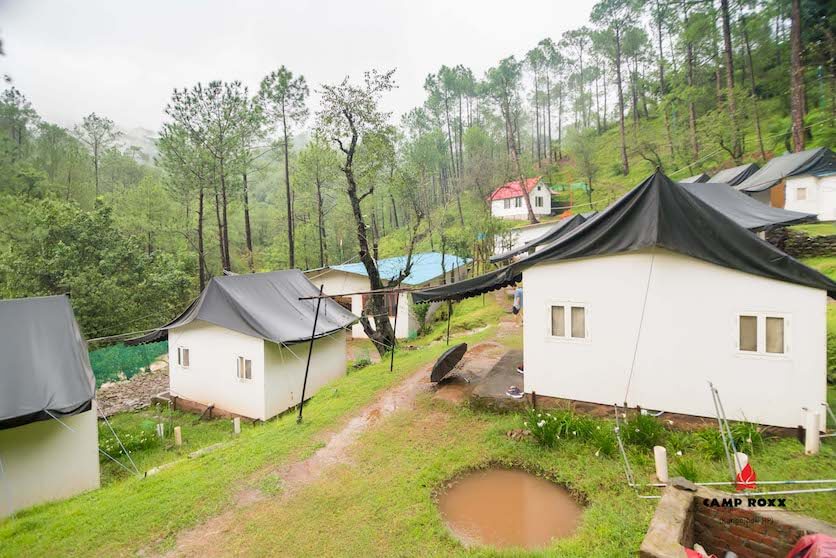
Venue types and what they suit:
- Adventure camps (e.g., Camp Roxx, Camp Wild Dhauj): Team bonding, outdoor activities, nature immersion. Browse venues →
- Luxury resorts (e.g., Westin Sohna, ITC Grand Bharat): C-suite retreats, polished MICE, reward trips
- Heritage properties (e.g., Neemrana Fort Palace): Themed events, leadership retreats
- Rural/farm stays (e.g., Pratapgarh Farms): Large day outings, ice-breakers on a budget
Plan the Agenda
The biggest agenda mistake we see — after 17 years and hundreds of corporate groups — is overpacking. HR managers try to squeeze a strategy session, three workshops, a team-building exercise, an awards ceremony, and a “fun evening” into a single day. By 4 PM, half the group is mentally checked out.
1-night/2-day agenda framework:
| Time | Day 1 | Day 2 |
|---|---|---|
| 9:00–10:00 | — (travel / arrival) | Breakfast |
| 10:00–12:00 | — | Structured session (workshop or strategy) |
| 12:00–1:00 | Arrival + check-in + lunch | Lunch |
| 1:00–2:00 | Settle in | Feedback + closing |
| 2:00–4:30 | Ice-breaker + team building activities | Departure |
| 4:30–5:00 | High-tea break | — |
| 5:00–6:30 | Structured session (workshop) | — |
| 6:30–7:30 | Free time / nature walk | — |
| 7:30–8:30 | Dinner | — |
| 8:30–10:30 | Bonfire + music + awards | — |
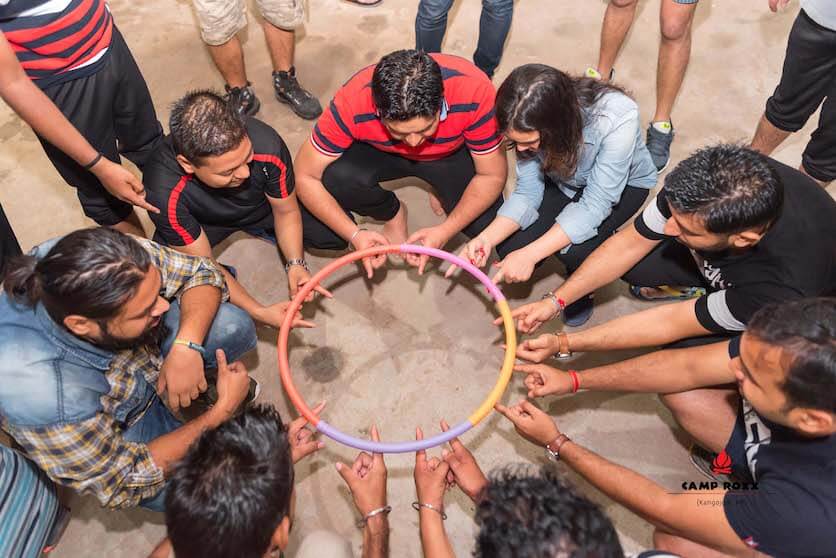
For team building activity ideas that work for groups of 20–100, see our activity guide.
Handle Logistics
Logistics is where most offsites silently fail. The retreat might be great, but if the bus was late, the food didn’t account for Jain preferences, or the projector lacked an HDMI cable — that is what people remember.
Transport options (India-specific):
| Group Size | Option | Approximate Cost |
|---|---|---|
| 10–15 | Tempo traveller (12-seater) | INR 12–18/km |
| 15–26 | Tempo traveller (26-seater) | INR 15–25/km |
| 30–50 | AC bus (45-seater) | INR 18,000–25,000/day |
| 50–100 | Multiple buses | INR 18,000–25,000/day per bus |
Logistics checklist:
- Confirm dietary requirements 2 weeks before (veg/non-veg/Jain/vegan/allergies)
- Share Google Maps pin + written directions (not just an address)
- Confirm AV equipment at venue (projector resolution, HDMI vs VGA, mic type)
- Arrange medical kit and note nearest hospital location
- Share packing list (comfortable shoes, light jacket for hills, power bank)
- Designate an emergency contact who is NOT part of the programme team
Communicate with Your Team
Poor pre-offsite communication leads to wrong expectations, late arrivals, and disengaged participants. Start 3 weeks before departure.
| When | What to Share |
|---|---|
| 3 weeks before | Announcement: dates, location, purpose. Keep it exciting, not corporate-memo-dry. |
| 2 weeks before | Logistics: transport details, reporting time, packing list, dietary form link |
| 1 week before | Final itinerary + room assignments + emergency contacts |
| 1 day before | WhatsApp reminder: departure time, pickup point, what to bring |
Execute the Offsite
On the day, your job shifts from planner to coordinator:
- Arrive 30 minutes before the group to walk the venue, confirm room readiness, and brief venue staff
- Designate one internal coordinator who handles logistics so leadership can focus on the programme
- Start with energy, not formality. An ice-breaker works better than a welcome speech
- Collect feedback BEFORE departure. Response rates drop from 80% to under 20% once people return to their desks
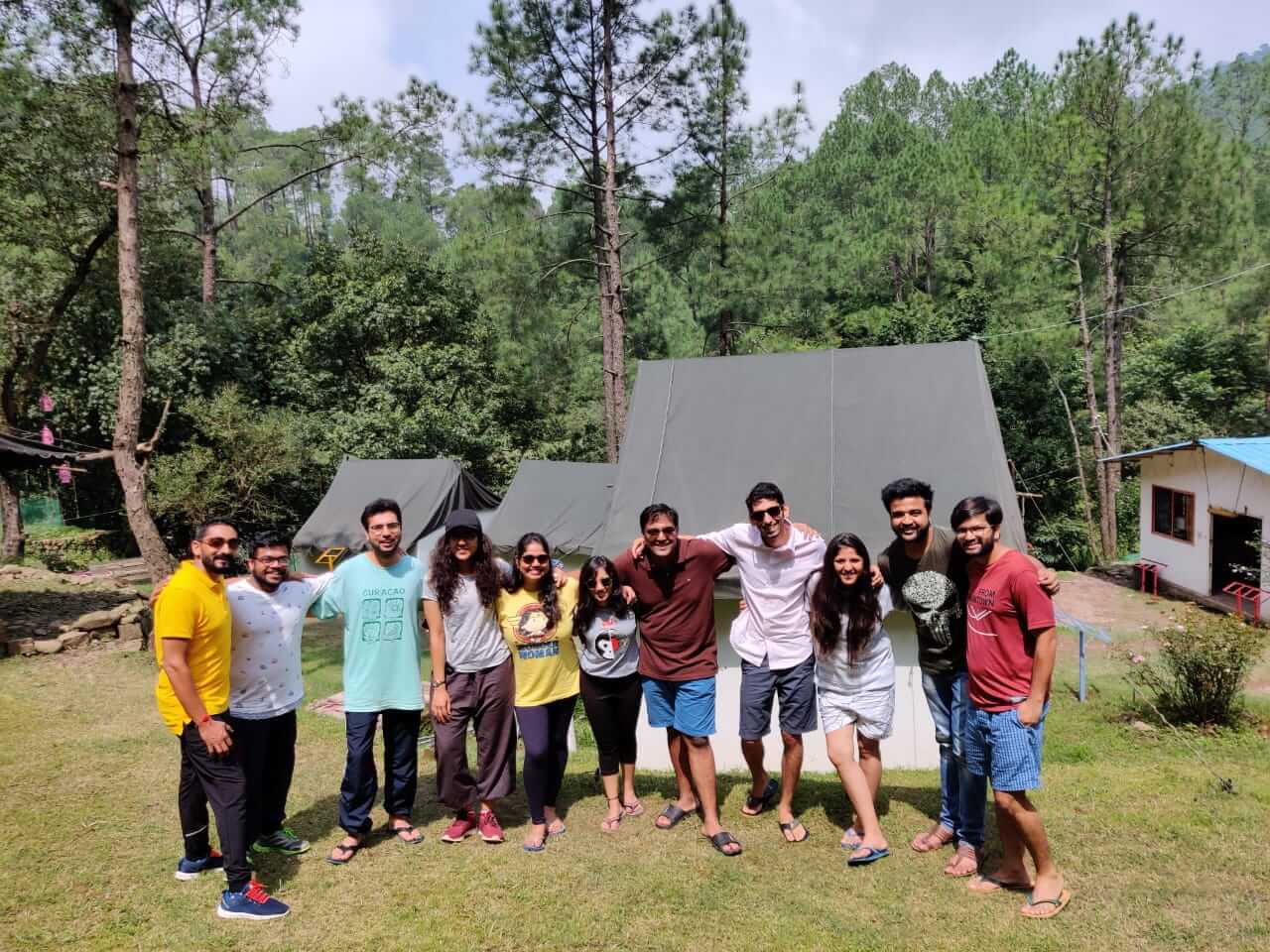
- Document everything. Assign someone to capture photos and short videos — these become powerful internal comms assets
Measure Success and Follow Up
An offsite without measurement is an expense. An offsite with measurement is an investment.
Post-offsite survey (send within 24 hours):
- On a scale of 1–10, how would you rate the overall experience?
- Did the offsite achieve its stated objective? (Yes / Partially / No)
- Name one colleague you connected with for the first time.
- What was the single best moment?
- What would you change for next time?
Metrics to track over 30–90 days:
| Metric | How to Measure | Good Benchmark |
|---|---|---|
| Satisfaction | Post-offsite survey (Q1) | Average 8+/10 |
| New connections | Survey Q3 | 70%+ name at least 1 |
| Retention | HR data: attrition in offsite cohort | Lower than non-attendees |
| Collaboration | Manager feedback at 60 days | Reported improvement |
| Objective met | Compare to Step 1 | Roadmap aligned? Trust improved? |
Share a summary report with leadership within 2 weeks — include highlights, photos, survey scores, and recommendations. This builds the case for recurring budget allocation.
Corporate Offsite Budget Breakdown: Where the Money Goes
For a mid-range 1-night/2-day offsite for 50 people near Delhi, here is a realistic cost breakdown:
| Category | % of Budget | Estimated Cost (50 pax) | Notes |
|---|---|---|---|
| Venue + accommodation | 40% | INR 1,25,000–2,50,000 | All-inclusive packages simplify this |
| Transport | 20% | INR 36,000–50,000 | 1 AC bus, round trip, 250–300 km |
| Food & beverages | 15% | INR 37,500–75,000 | Often included in venue package |
| Activities & facilitation | 15% | INR 37,500–75,000 | Often included in venue package |
| Miscellaneous | 10% | INR 25,000–50,000 | Decor, awards, photography, first aid |
| Total | 100% | INR 2,60,000–5,00,000 | INR 5,200–10,000 per person |
If your venue offers all-inclusive packages (accommodation + meals + activities + conference room in one rate), the venue line item absorbs food and activities. For venues with all-inclusive corporate packages, explore options with a single per-person rate.
7 Common Offsite Planning Mistakes (and How to Avoid Them)
After hosting corporate groups for 17 years, we have seen every mistake in the book. Here are the seven that come up most often:
Sample 2-Day Corporate Offsite Itinerary
This is a real itinerary framework we use at Camp Roxx for groups of 30–60 people on a weekend leadership offsite. Adjust timing and activities based on your venue and objectives.
Day 1 (Saturday)
| Time | Activity | Location | Notes |
|---|---|---|---|
| 7:00 AM | Departure from Delhi-NCR | Office / pickup point | AC bus, breakfast packs on board |
| 12:30 PM | Arrival + welcome drinks | Camp reception | Brief orientation by coordinator |
| 1:00 PM | Lunch (buffet) | Dining area | Veg + non-veg pre-confirmed |
| 2:00 PM | Check-in + freshen up | Cabins | 30 min to settle in |
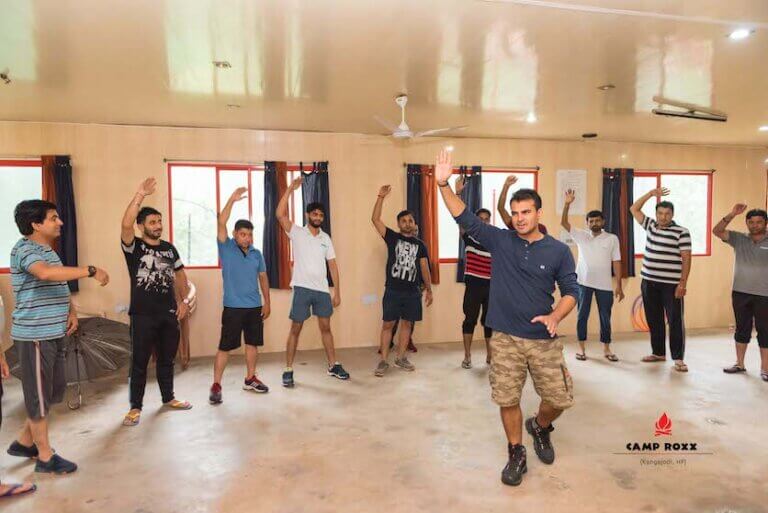
| 2:30 PM | Ice-breaker: Key Punch | Activity ground | 4 teams, high energy |
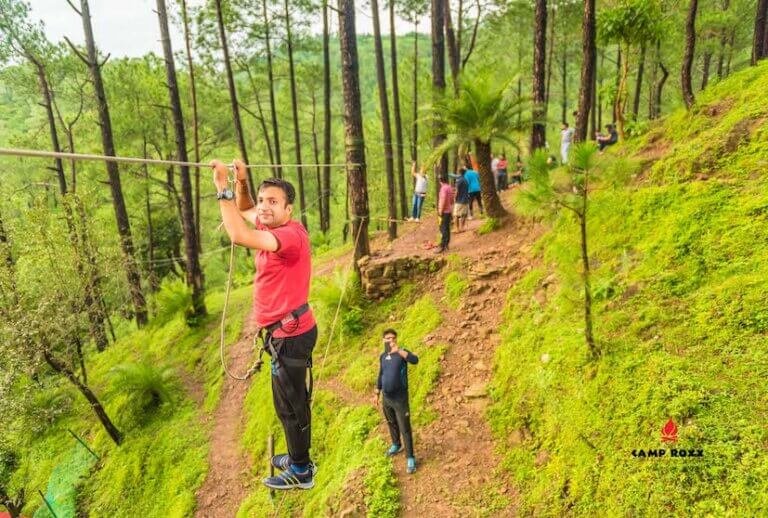
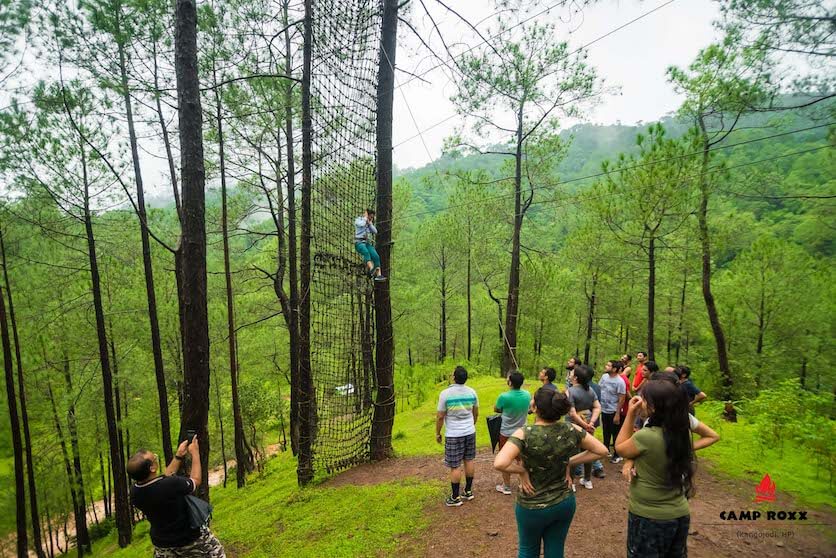
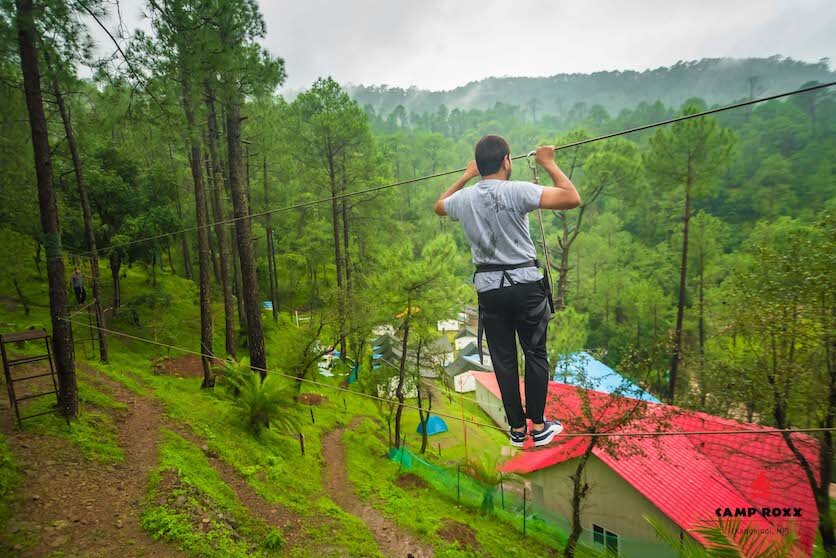
| 3:15 PM | Burma Bridge → Zipline → Commando Net | Forest circuit | 3 groups rotating, 20 min each |
| 4:30 PM | High-tea + break | Dining area | |
| 5:00 PM | Strategy session / workshop | Conference hall | Projector + U-shape, 90 min |
| 6:30 PM | Free time / nature walk | Forest trails | Optional guided trek |
| 7:30 PM | Dinner | Dining area | |
| 8:30 PM | Bonfire + music + awards | Bonfire area | DJ, lights, open mic |
Day 2 (Sunday)
| Time | Activity | Location | Notes |
|---|---|---|---|
| 7:30 AM | Breakfast | Dining area | |
| 8:30 AM | Morning energiser: Magic Mat | Activity ground | Quick 20-min team game |
| 9:00 AM | Structured session: retrospective | Conference hall | Productive morning — focus is highest |
| 11:00 AM | Final challenge: Pipes & Marbles | Activity ground | Collaborative, requires communication |
| 11:45 AM | Feedback + group photo | Conference hall | Physical forms + 3-question survey |
| 12:00 PM | Lunch | Dining area | |
| 1:00 PM | Check-out + departure | Camp reception | |
| 6:30 PM | Arrival back in Delhi-NCR | Office / drop point |
This puts Day 1 afternoon on high-energy physical activities (people need to decompress after a long drive), the formal session in the early evening, and the most productive work session on Day 2 morning — when focus is naturally highest after a good night’s sleep and informal bonfire bonding.