
Nahan is a small hill town in Sirmour district, Himachal Pradesh, that most Delhi travelers drive past on the way to somewhere more Instagrammed. The places worth your time here are Renuka Lake (14 km from town), Suketi Fossil Park, Trilokpur Temple, the Churdhar Trek starting point, and Jaitak Fort — each worth a dedicated half-day. Nahan works best as a 2–3 night base, not a day stop.
There’s a clock tower in Nahan’s main chowk that nobody photographs. It’s been there since the 1880s, built during the Sirmour princely state era. At 7 AM on a weekday, when the bazaar is just waking up — vegetables being unloaded, chai being poured into glasses not mugs — that clock tower is the best version of Nahan. No tourists. No filtered content. Just a quiet Pahari hill town doing its morning.
That version of Nahan doesn’t appear on any travel blog, because the blogs haven’t been there at 7 AM. Our guide has.
Here’s what’s actually worth your time in Nahan and the surrounding Sirmour district in order of priority, with honest assessments of each.
Renuka Lake: The One Place Worth the 14 km Drive
Renuka Lake is the largest natural lake in Himachal Pradesh and sits 14 km from Nahan town on a road that takes about 25 minutes by car. The lake is named after the goddess Renuka, and the temple complex on its banks is active — this is a place of genuine religious significance, not just scenic value.
Come before 9 AM or after 4 PM. The middle of the day, especially on weekends, fills up with families who’ve driven in from Nahan and nearby towns. The lake itself is roughly 3 km in circumference — you can walk the full loop in under an hour.
There’s a small zoo adjacent to the lake with lions, leopards, and crocodiles. It’s a legitimate zoo, not a petting farm. Whether you visit depends on your feelings about zoos. The entry fee is nominal (₹30–50 per person as of early 2025, though confirm this when you visit).
What makes Renuka Lake worth it: The migratory birds. Between November and February, the lake draws bar-headed geese, brahminy ducks, and common teal. If you’re not a birder, you’ll still notice. If you are, bring binoculars.
What to skip: The boat rides on weekday afternoons feel like obligation. The queue is short but the ride adds nothing the shoreline walk doesn’t already give you.
The Renuka Fair happens every November, drawing thousands of pilgrims. If you’re there during the fair, expect crowds that change the character of the place entirely. It’s worth seeing once for the cultural experience. It’s not a quiet retreat.
If you’re staying at Camp Roxx, Renuka Lake is a natural Day 2 morning trip — leave the camp by 6:45 AM, arrive before 8, walk the lake, have chai at one of the dhabas near the temple, and be back before noon.
Suketi Fossil Park: The One Nahan Attraction Most Blogs Get Wrong
Every Nahan travel blog lists Suketi Fossil Park. Almost none of them tell you what it actually is.
Suketi is a paleontological site, not a theme park. Discovered in 1974, the Shivalik Hills around the Suketi River have yielded fossil remains dating back 2.5 million years — prehistoric elephant, horse, hippopotamus, and crocodile species that no longer exist. The park has life-size fiberglass replicas of these animals placed across a forested landscape, which sounds gimmicky but lands better than expected.
The park is 22 km from Nahan on NH707. Drive time is around 35 minutes.
What works here: The scale of the replicas puts Shivalik prehistory into physical perspective in a way that no museum could. A life-size replica of Stegodon — an extinct proboscidean — next to a walking path does something to your sense of deep time that reading about it doesn’t.
What doesn’t: The interpretive signage is dated and sparse. If you have kids who are into dinosaurs or prehistoric animals, bring your own background knowledge. They’ll have questions the signs can’t answer.
Practical: Entry is around ₹30 for adults, ₹10 for children. The park is open 10 AM–5 PM (closed Mondays). Half a day is enough. Don’t combine it with Renuka Lake on the same day — you’ll rush both.
Trilokpur Temple: A Hike Worth More Than Its 15 Minutes of Fame
Trilokpur Temple is a Shakti temple dedicated to Mahashakti Tribhuvanasundari and sits on a forested hilltop 24 km from Nahan. The temple dates back to 1573. Two large fairs are held here annually — Chaitra Navratri (March–April) and Ashvin Navratri (September–October) — and on those days the approach road is impassable by car from 5 km out.
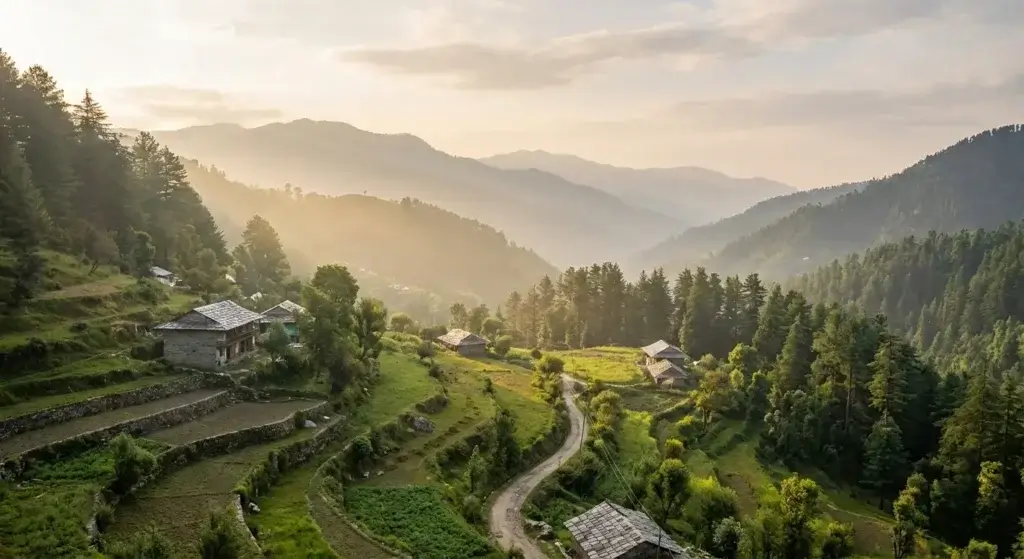
On ordinary days, Trilokpur is genuinely peaceful. The drive up through oak and rhododendron forest is the kind of road that makes you slow down involuntarily.
The honest assessment: The temple itself is relatively modest in scale. The value is in the setting and the journey. If you’re a pilgrim, this is a significant religious site and the experience lands differently. If you’re a traveler looking for impressive architecture, manage expectations.
When to go: Tuesday and Saturday are considered auspicious and draw local devotees, which adds atmosphere without the chaos of the full fair seasons. Weekday mornings are almost empty.
Time needed: 2 hours including drive from Nahan, time at the temple, and the descent.
Churdhar: The Trek Most Sirmour Visitors Skip (They Shouldn’t)
Churdhar Peak sits at 3,647 metres and is the highest peak in the outer Himalayas of Himachal Pradesh. The trek to the summit is 14 km one way from the Nohradhar base, and the base itself is 85 km from Nahan — roughly 2.5 hours by car.
Most people visiting Nahan don’t make it to Churdhar. That’s exactly why the trail is worth it.
The trail: The standard route goes through dense cedar, oak, and rhododendron forests before breaking into alpine meadows near the summit. There’s a temple of Shirgul Maharaj at the top — a significant pilgrimage site for the Sirmour region. On clear days (October and November are the most reliable), you can see into Tibet.
Difficulty: Moderate to strenuous. The gain is about 1,400 metres over 14 km. Anyone who’s done a full-day trek before can handle it. First-timers should be prepared for the distance.
Practical details:
- Start from Nohradhar. Homestays are available there if you want to do the trek over 2 days (recommended).
- Best months: May–June and September–November. Avoid July–August (heavy rain, slippery trail) and December–February (heavy snow, trail often inaccessible).
- No permit required as of early 2025, but verify before going as regulations change.
- Carry your own food and water for the day. The only reliable water source on the trail is a spring roughly halfway up.
If you’re staying at Camp Roxx: The camp team can help arrange a driver to Nohradhar and advise on current trail conditions. The Churdhar day is genuinely the highlight of a Sirmour itinerary for anyone with reasonable fitness.
Jaitak Fort: For People Who Don’t Mind Earning Their View
Jaitak Fort is 35 km from Nahan, perched at around 1,400 metres. It was a key defensive position during the Anglo-Gorkha War of 1814–15 — the British, under Major-General Martindell, failed three times to capture it before the Gorkha forces finally withdrew. The fort held.
Most of what remains is ruins. That’s not a warning, it’s the point.
The road to Jaitak is narrow and in poor condition for the last 8 km. A 4×4 or high-clearance vehicle is strongly recommended. In a standard sedan, you’ll make it but you won’t enjoy it.
What’s there: The ruins sit in dense forest. There are no crowds, no entry fees, no crowds on weekdays. The views over the Shivalik range from the fort walls are among the best in the district.
Time needed: Half a day from Nahan, including driving.
Who should go: Travelers interested in history, fort trekking, or simply finding a place in Himachal Pradesh where they are alone with their thoughts. Not suited for families with young children or anyone relying on a standard hatchback.
FAQs About Places To Visit In Nahan
Is Nahan worth visiting?
Yes, if you want a genuinely un-touristy hill destination within 250 km of Delhi. Nahan is not dramatic in the way Manali is. It’s a working Pahari town with specific points of interest — Renuka Lake, Suketi Fossil Park, the Churdhar Trek — that reward travelers who come with curiosity rather than a highlight reel. It’s a poor fit if you’re looking for ski resorts, crowded markets, or luxury hotels.
How far is Nahan from Delhi?
Nahan is approximately 250 km from Delhi depending on where your house is located in the NCR. The most practical route is Delhi → Panipat → Ambala → Saha → Kala Amb → Nahan. In normal traffic, this takes 5.5–6 hours. Leave Delhi by 5–6 AM on a Friday and you’ll arrive before noon.
What is Nahan famous for?
Nahan is known for three things: Renuka Lake (the largest natural lake in Himachal Pradesh), the Suketi Fossil Park (a significant paleontological site with Shivalik-era fossils), and as the former capital of the Sirmour princely state. It’s also the starting point for reaching the Churdhar Trek, the highest peak in the outer Himalayas at 3,647 metres.
What is the best time to visit Nahan?
October to March is the most reliable window. October and November give you clear skies, post-monsoon greenery, and the Renuka Lake migratory bird season. December and January are cold but accessible — Nahan sits at around 930 metres, so heavy snowfall is rare. March is warm and pleasant. Avoid late June through August if rain and road slippery are concerns, though Nahan itself remains accessible during monsoon — just expect some disruption on forest approach roads.
Can you visit Nahan in a day trip from Delhi?
Technically, yes. Practically, it’s a bad idea. The 6-hour drive each way leaves you 4–5 hours in Nahan, which isn’t enough to do more than drive past Renuka Lake. The point of Nahan is the slower pace and the surrounding territory. Two nights minimum is the right commitment.
Is Nahan good for families?
It works well for families with children aged 8 and older. Suketi Fossil Park is particularly good for older kids with an interest in natural history. Renuka Lake has the zoo. The Churdhar Trek is not suitable for young children. Accommodation options are limited compared to Shimla or Kasauli — plan this before booking.